At Mallorca SUPCO, we have long championed paddle boarding and the ocean as a positive tool for wellbeing, confidence and connection. That comes partly from personal experience.
The sea and paddle boarding became an important source of calm, focus and perspective during a difficult period of recovery — and helped shape the idea behind Mallorca SUPCO in the first place.
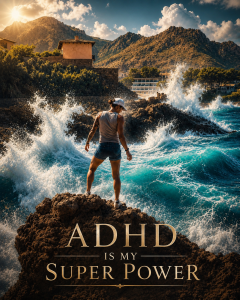
For someone living with ADHD, racing thoughts, or anxiety that can overwhelm, the combination of movement, fresh air, open space and the gentle rhythm of the water can offer something incredibly powerful: a chance to pause, reset and come back to the present.
Of course, there is no one-size-fits-all experience. Neurodiversity is not something that needs fixing, and what feels calming or supportive for one person may feel very different for another.
But when conditions are right, time on the water can create a wonderfully supportive environment — one that allows people to move at their own pace, feel connected to nature and simply be themselves.
So, why can interacting with water help?
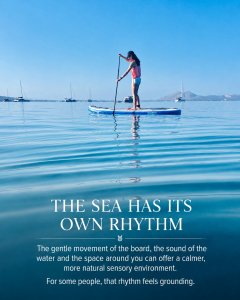
The sea has its own rhythm
Life on land can be noisy, fast and full of demands. Traffic. Phones. Conversations. Bright lights. Crowded spaces. Instructions. Expectations. The constant feeling of needing to keep up.
Out on the water, much of that falls away. The gentle movement of the board, the rhythm of the paddle, the sound of the sea and the space around you can create a calmer sensory environment. There is still plenty to notice — the sun on your skin, the movement beneath your feet, the birds overhead and the changing colours of the water — but it is often a more natural and predictable kind of sensory input.
For some people, that rhythm can feel grounding. For others, it can provide just enough stimulation to feel more present, focused and settled.
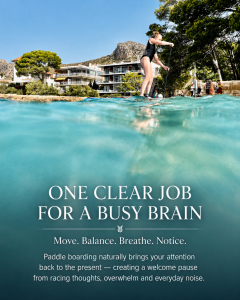
Paddle boarding gives the brain one clear job
When you are on a paddleboard, your attention naturally comes back to the here and now.
Where is my body?
How is the board moving?
What is the wind doing?
Where am I placing my paddle?
What can I see beneath me?
It is difficult to be everywhere at once when you are gently balancing on the sea.
That does not mean your thoughts magically disappear, but paddle boarding can create a welcome pause from overthinking, rumination and the background noise of everyday life. The brain is given a simple, physical task: move, balance, breathe and notice.
For many people, it feels a little like meditation — without having to sit still and try to meditate.
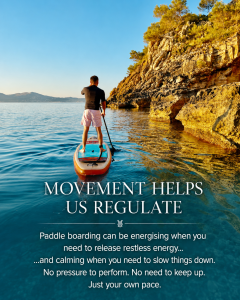
Movement can help us regulate
We are not designed to spend all day sitting still, staring at screens and trying to force our brains into one particular pace.
Paddle boarding brings together steady movement, balance, coordination and fresh air. It can be energising when you need to release restless energy, but calming when you need to slow things down.
There is no treadmill. No whistle. No crowded gym. No pressure to keep up with anyone else.
You can paddle gently. You can sit down. You can kneel. You can lie back on the board and look at the clouds. You can laugh when you wobble. You can go at your own pace.
That freedom matters.
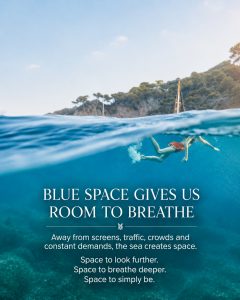
Blue space gives us room to breathe
There is something about being near water that changes the way many of us feel.
Maybe it is the horizon. Maybe it is the sound. Maybe it is the fact that the sea does not ask anything from us.
On a board, you are away from the usual walls, roads, queues and routines. You have space around you. You can see further. You can breathe deeper. You can look down and spot fish, jellyfish, Posidonia or simply the shifting light beneath your board.
For people who feel overwhelmed by busy environments, that sense of space can be a huge relief.
And for people who spend a lot of time feeling misunderstood, judged or expected to fit into a particular box, the ocean can feel wonderfully neutral.
You do not have to perform on the sea. You just have to be there.
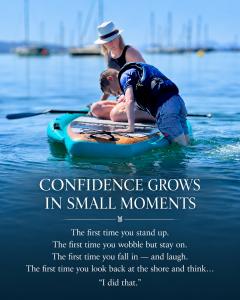
Confidence grows quietly
Paddle boarding is full of small wins.
The first time you stand up.
The first time you paddle in a straight line.
The first time you wobble but stay on.
The first time you fall in and realise it is actually quite funny.
The first time you look back at the beach and think, I did that.
Those moments can build confidence in a very natural way.
Not loud, competitive, “look at me” confidence. More the quiet kind:
I can try new things.
I can trust my body.
I can work things out.
I am capable.
That feeling can travel far beyond the board.
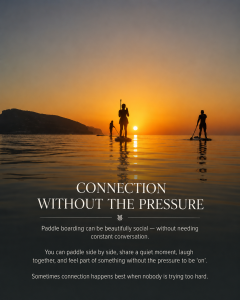
Connection — without the pressure
Paddle boarding can be beautifully social, but it does not have to be intense.
You can paddle quietly alongside someone without needing constant conversation. You can share a sunrise with a group, laugh together when somebody takes an unexpected swim, or simply enjoy being part of something without feeling the pressure to be “on”.
For some people, that side-by-side connection can feel much easier than sitting face-to-face in a noisy café or trying to make small talk in a busy room.
The sea gives people something else to focus on together: the light, the wildlife, the next little bay or the feeling of the board moving beneath their feet.
Sometimes connection happens best when nobody is trying too hard.
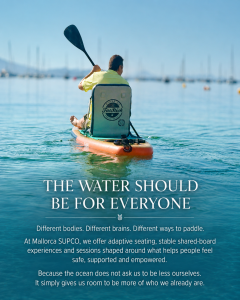
Inclusion is not an add-on
At Mallorca SUPCO, we believe that the water should be for everyone.
That is why we have created different ways for people to take part, depending on what feels right for them.
Our adaptive seats from our friends at Fatstick offer a more supported way to paddle, while Big Ron — our large, stable paddleboard — allows for shared experiences with extra reassurance and support.
Some people may prefer a quieter session. Some may need more time. Some may want clear instructions before getting on the water. Some may feel more comfortable sitting or kneeling rather than standing. Some may simply need to know that falling in is not the end of the world.
All of that is okay.
The best paddleboarding experience is not about making everybody do the same thing. It is about meeting people where they are, working with their strengths and creating an experience that feels safe, enjoyable and empowering.
The sea is not a therapy room — but it can be therapeutic. Paddle boarding is not a replacement for clinical support, therapy or medical care. But it can be a brilliant tool for wellbeing.
For some people, it is a chance to release energy. For others, it is a chance to find stillness. For some, it is about building strength and balance. For others, it is about reconnecting with nature, finding confidence or remembering what joy feels like. Often, it is all of those things at once.
At the heart of it, paddle boarding offers something wonderfully simple: a board, a paddle, a patch of blue space and the freedom to move through the world in your own way.
And sometimes, that is exactly what we need.
Because the ocean does not ask us to be less ourselves. It simply gives us room to be more of who we already are.
Maluhia a me ke aloha (peace and love)
Hanna Tramuntana
Hannah Louise López is the founder of Mallorca SUPCO and Oceans Connected Mallorca. An ocean storyteller and passionate advocate for Blue Health, she uses paddle boarding, photography and small-scale adventure to help people connect more deeply with the sea — and, often, with themselves.